


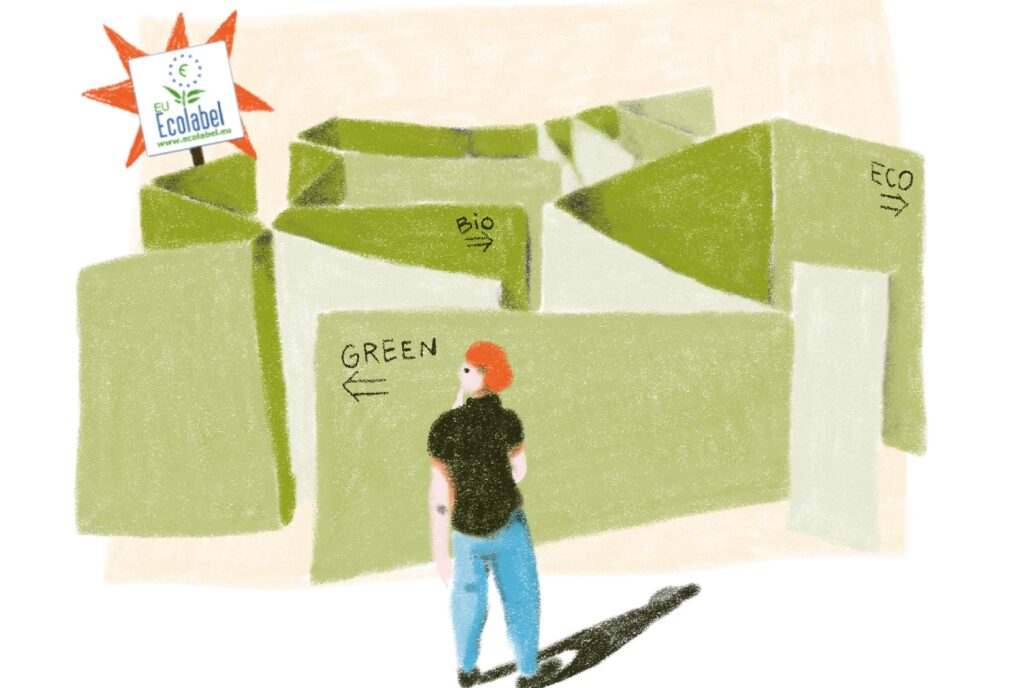
Telling sustainable products from greenwashing is too often a guessing game. This is set to change, thanks to new EU rules and the EU Ecolabel, write Roberta Arbinolo and Miriam Thiemann.
From food and clothing to cosmetics and detergents, environmental claims are everywhere. But for consumers trying to make more sustainable choices, knowing which claims to trust can be surprisingly difficult.
A new EU law – the Empowering Consumers for the Green Transition Directive – is making it easier. The new rules, which have just taken effect across the EU, prohibit a series of misleading marketing practices and strengthen requirements for environmental claims and sustainability labels – an important step towards making sustainable shopping choices less of a headache.
The need is clear. According to the European Commission, three out of four products on the EU market carry an explicit or implicit environmental claim. Yet more than half of these claims are vague, misleading or unfounded. At the same time, almost half of the 230 ecolabels identified in the EU have weak or no verification procedures.
For consumers, this can create a confusing marketplace in which genuinely greener products compete for attention in a jungle of green advertisement.
Civil society has been calling out greenwashing for years
Across Europe, civil society groups – including members of the European Environmental Bureau (EEB) – have spent years investigating questionable environmental claims, challenging companies and pushing authorities to tackle misleading marketing.
ClientEarth has been a pioneer of challenging corporate greenwashing through legal action, in Europe and beyond. Following their world-first complaint against BP’s advertising, they worked with investigative journalists to take on some of the world’s biggest fossil fuel corporations and highlight how their marketing does not always match up to reality, as documented in their Greenwashing Files.
In France, France Nature Environnement (FNE) filed a complaint against Coca Cola – the world’s largest corporate plastic polluter – for deceptive business practices and greenwashing at the Paris 2024 Summer Olympics. After major announcements by the company that beverages would only be served to spectators in reusable cups to reduce packaging waste, FNE revealed that over 6 million drinks were actually poured into sustainable containers from plastic bottles that were then discarded out of sight, while letting consumers believe in a fake eco-friendly image.
In Germany, Deutsche Umwelthilfe (DUH) has made calling out greenwashing a central part of its work. Their yearly Golden Vulture award highlights particularly absurd environmental marketing, while the organisation has also taken companies to court over deceptive green claims. One case involved challenging Apple for marketing some of their watches as ‘climate neutral’; the claim was based on compensation projects including eucalyptus plantations that were only secured to be cultivated until 2029. This is precisely the kind of greenwashing the new EU rules are designed to tackle.
Green marketing gets a reality check
While greenwashing was already illegal under previous rules, specific cases are now clearly spelled out and specifically prohibited. For example, generic environmental claims such as “eco” or “green” face stricter conditions, while sustainability labels must be based on certification schemes that include independent verification.
Moreover, companies can no longer make “climate neutral” claims about products when these are based on carbon offsetting – a practice that has been widespread until today and led to the proliferation of some of the most misleading green claims on the market.
The Directive also targets premature obsolescence practices that force consumers to replace products sooner than necessary. Traders cannot advertise products when they know they contain a feature designed to limit their durability. Besides, a new “GARAN” label allows traders to highlight products for which they offer a longer guarantee than the legal minimum free of charge.
Taken together, these measures prevent some common greenwashing tactics, while providing consumers with better information about a product’s durability.


A label consumers can trust
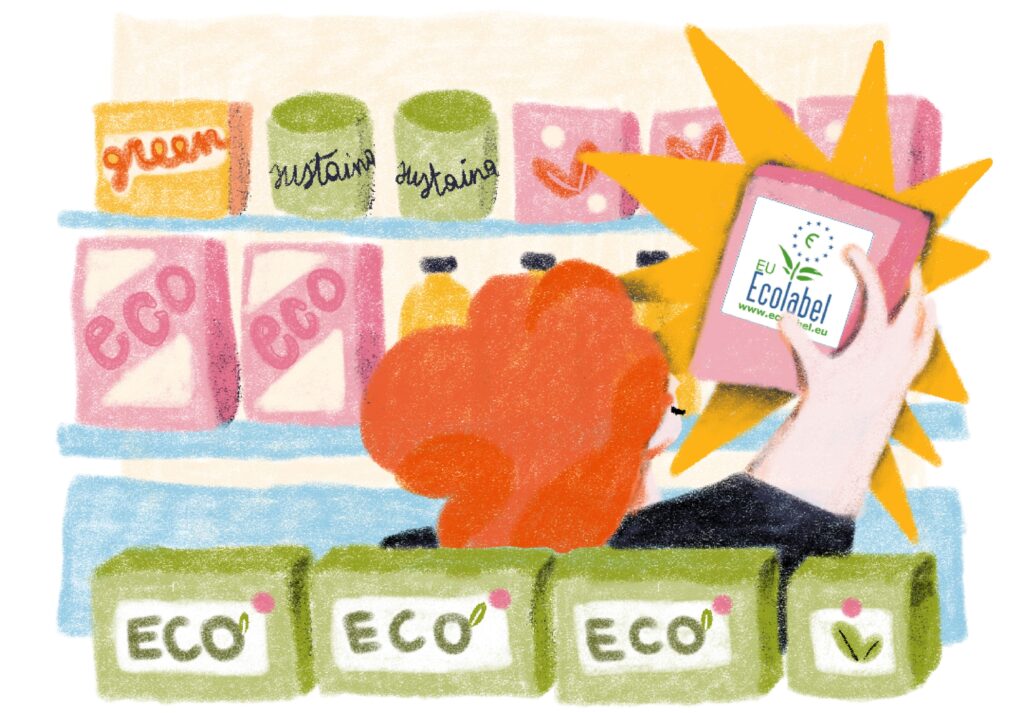
One tool that can help companies and consumers alike is the EU Ecolabel, the EU’s official sustainability label for goods and services that meet high environmental and health standards.
It is a certification that addresses environmental impacts across a product’s lifecycle, from production through to use and disposal. The goods and services carrying the label must meet strict criteria and undergo independent verification. The requirements are set by the European Commission in collaboration with Member States and stakeholders representing SMEs, consumers and environmental groups. This includes the EEB and the European Consumer Organisation (BEUC).
The EU Ecolabel is explicitly mentioned in the directive as accepted justification for generic green claims, making it easier for the companies that certify their products to comply.
The good news is, the EU Ecolabel keeps expanding. New figures published today, on World Ecolabel Day, show that the scheme now covers 121,083 goods and services on the European market, under 3,665 licenses – showing a 4% increase within half a year. About two thirds of the licenses are held by small and medium enterprises (SMEs).
Consumer awareness and trust are growing too. According to a recent EU survey, an increasing share of Europeans recognises the EU Ecolabel’s logo, and almost half of the respondents say they buy EU Ecolabel-certified products at least occasionally.
The latest figures put the number of EU Ecolabel licences and certified products at an all-time high, reflecting growing interest among businesses, retailers and consumers in products that are eco-friendly, innovative and competitive.
In fact, an advantage of the EU Ecolabel that should matter to anyone worried about their household budget is that certified products are often cheaper than conventional alternatives – as shown by a recent supermarket check run by the EEB and BEUC. This challenges the myth that buying green is necessarily more expensive. Actually, the experiment showed that the real barrier is often not the price, but the availability of ecolabelled products, which is still uneven across EU countries, despite the steady growth of the certification scheme access the board. To address this challenge, environmental and consumer organisations have been calling on retailers to increase their offer of products carrying the EU Ecolabel or an equivalent label, and help make the sustainable choice the easy choice.
Now the new rules must be put to work in practice
As Europeans look for products that are better for the environment and their health, the market must give them information they can trust. Choosing a more sustainable product should not require consumers to become environmental detectives.
The Empowering Consumers Directive is a significant step towards making that possible – but legislation only works if it is put into practice.
EU Member States were given two years to transpose the new rules into national law, yet many missed the deadline. The EEB is calling on governments to complete the process and ensure the rules are properly enforced without delay.
Companies, meanwhile, should not wait until they come under scrutiny: they should pro-actively review their environmental claims and ensure they comply with the new requirements. For businesses that are genuinely investing in more sustainable products, the EU Ecolabel offer a credible way to back up their environmental performance and help them stand out.

If you enjoyed this article, please consider buying the author a coffee.

