


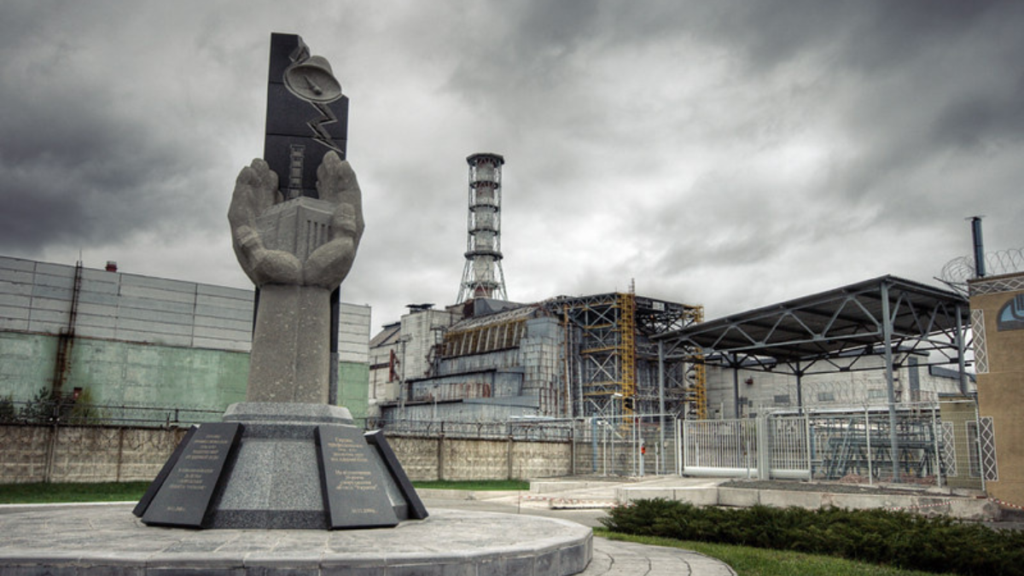
The 40th anniversary of the Chornobyl disaster forces us to confront the truth: nuclear energy is not just another technology. It is a system whose failures, whether triggered by human error, extreme weather events or armed conflict, leave consequences that last longer than political cycles, longer than a generation, longer than states. At a time when proponents are trying hard to bring it back, Chornobyl invites us to revisit the human and financial costs of nuclear energy, and to make safer, more sustainable and less costly choices for future generations, writes Patrizia Heidegger, EEB Deputy Secretary General.
The Chornobyl legacy
Chornobyl’s legacy is not abstract. It is written in elevated cancer rates. It is written in contaminated soils and rivers. It is written in the lives of workers who cleaned up the disaster without protection and in the communities that continue to face long-term health impacts decades later.
Nuclear radiation does not negotiate. It does not respect borders. It does not fade when the news cycle moves on.
Beyond its devastating physical impacts, the Chornobyl disaster remains one of the most expensive industrial failures in history, with total costs estimated in the hundreds of billions of dollars for health care, resettlement, lost agricultural and industrial output, environmental cleanup and decades of social support. Different parts of the EU were not only heavily affected by radiation, but the EU has also been the largest international donor to the works.
Chornobyl is one of my earliest childhood memories. I was in kindergarten when the radioactive fallout hit the South of Germany and Austria through heavy rainstorms from contaminated clouds. ‘Don’t touch the wet grass’ and ‘Don’t play on the street’ -nobody knew what to do. This panic and the stories of the cancer children of Chornobyl in Ukraine and Belarus has made the threat of nuclear power very real for me.”
Patrizia Heidegger, Deputy Secretary General EEB
Ukraine still allocates large shares of its national budget each year to Chornobyl related programmes. Millions of people continue to require medical monitoring, and vast areas of land remain unusable. These staggering, multigenerational costs expose the myth of “cheap” nuclear power and reveal the true economic burden that accidents like this one impose on societies. While renewable energy projects are among the large projects with lowest associated cost overruns and delays, nuclear energy and waste storage sites are among the worst performers.
Fukushima: a reminder that nature, too, can create nuclear disaster
If Chornobyl exposed the dangers of flawed design and political secrecy, Fukushima showed that even reactors with stronger safety design are not immune to disaster.
A single natural event, a massive earthquake followed by a tsunami, was enough to trigger core meltdowns, mass evacuations and long-term contamination. More than a decade later, cleanup continues, and displaced communities still struggle to return home.
Climate change only heightens these risks. Rising seas, extreme weather, droughts, and floods all threaten the cooling systems and infrastructure nuclear plants depend on. In a warming world, the idea of “once-in-a-century” events is becoming meaningless.
As a result of the Fukushima disaster, tens of thousands of people were permanently displaced; entire communities lost their livelihoods, and vast areas of land and coastal ecosystems required unprecedented cleanup efforts. The decommissioning of the damaged reactors is expected to take 40–50 years, with no guarantee that current technologies will be sufficient.
The Japanese government estimates total expenses at over $200 billion, and independent analyses placing the true long-term cost far higher once decontamination, compensation, decommissioning and health monitoring are included.
These immense, ongoing costs reveal the profound economic risks of nuclear power, risks that persist long after the initial accident, and that no private insurer is willing to bear.
Zaporizhzhia: nuclear power is not war-proof
Russia’s illegal attack on Ukraine has shattered another illusion: that nuclear power can be insulated from conflict and geopolitics.
The Zaporizhzhia nuclear power plant, Europe’s largest, has been shelled, occupied, disconnected from the grid and repeatedly forced into emergency cooling procedures. Each incident has brought the world uncomfortably close to another nuclear crisis.
No amount of engineering can make a reactor safe in a war zone. Nuclear power requires stability, security and functioning infrastructure. Conflict offers none of these.
The use of nuclear energy entails inherent limitations in transparency, which have led in the past – and will continue to lead—to tragedies, corruption and unjustified dependencies. In the end, people pay a high price for what is presented as a ‘reliable’ energy supply.”
Andriy Andrusevych, Resource & Analysis Center “Society and Environment”, EEB Vice-President
Rebuilding Ukraine back green
The 40th anniversary of Chornobyl is a stark reminder that the old energy model of the Ukraine – and far beyond – was built on sacrifice zones and state secrecy; the new one must be built on transparency, community power and commitment to a renewable future. There is an opportunity to break forever from the toxic legacy of both nuclear and fossil-based energy. Decentralised renewables – wind, solar and modernized grids – are also essential for resilience under wartime conditions and for reducing Ukraine’s dependence on imported fuels.
Rebuilding after Russia’s invasion is a once‑in‑generations chance to hardwire energy efficiency, renewables, and community‑owned energy systems into the country’s infrastructure, pushing toward a fully renewable energy sector by 2050 and empowering local communities to shape their own energy futures.
Beyond Chornobyl: the nuclear price tag
Leaving major accidents aside, proponents of nuclear energy like to describe it as “cheap” or “competitive.” But when all costs are included, from construction, financing, inevitable delays, fuel, security, decommissioning and waste management, nuclear reactors become the most expensive way to generate electricity.
Independent analyses consistently show that:
- New nuclear power is more expensive than wind, solar, and storage—often dramatically so.
- Construction delays and cost overruns are the norm, not the exception (e.g., Flamanville, Olkiluoto, Hinkley Point C).
- Decommissioning and waste storage costs are routinely underestimated, leaving society to pick up the bill.
- Potential catastrophic risk is effectively uninsurable, meaning governments and hence taxpayers shoulder the liability.
When the full economic picture is acknowledged, nuclear power is not a bargain. It is a long-term financial burden – and a serious health and safety risk.
Europe still has no operational deep geological repository for high-level waste. And even if Member States, such as Finland, are opening up deep geological deposits, long-term waste storage is unable to foresee distant future ecosystems and reflect the limits of human knowledge. Every reactor produces materials that remain hazardous for tens of thousands of years, longer than any human institution has ever survived.
To call nuclear “clean” while leaving behind a toxic legacy for hundreds of future generations is simply a lie.
What is frightening to me is a optimism of pro-nuclear advocates, as if they actually believe in their own promo materials. Time is not on their side, and with every year we are closer and closer to a third major nuclear catastrophe. In addition, with wars becoming new normal around the world, nuclear risks are really escalating.”
Toni Vidan, Friends of the Earth Croatia, EEB President
A renewable future is essential
The good news is that Europe – and the world – do not need nuclear power to decarbonise. We already have safer, cheaper and faster solutions. A 100% renewable energy system built on wind, solar, geothermal, sustainable storage, efficiency, reduction of energy use and smart grids offers:
- True energy independence, freeing Europe from fossil fuel imports and uranium supply chains.
- Lower costs for households and industry.
- A decentralised, resilient grid that cannot be held hostage.
- Cleaner air and healthier communities, reducing disease and premature deaths.
- Rapid deployment, essential for meeting climate targets.
Renewables do not melt down. They do not contaminate landscapes for centuries. They do not require evacuation zones. And they are faster and cheaper to build, meaning they are the best strategy for us to reduce carbon emissions fast.
Honouring Chornobyl means refusing to repeat the same mistakes
Commemorating the Chornobyl anniversary is not just about remembering the past. It is about choosing a different future.
A future where we stop gambling with technologies that can devastate entire regions.
A future where energy does not come with the threat of catastrophe or nuclear waste lasting hundreds of generations.
A future where climate action strengthens peace, health and democracy rather than undermining them.
Chornobyl, Fukushima and Zaporizhzhia are not isolated events. They are warnings. And they point us toward the same conclusion: the safest, most democratic, most resilient energy system is one built on renewables.