This article is based on the joint statement “Beyond bandages: Towards a European Affordable Housing Plan that is fair and sustainable”, co-signed by nine social and environmental NGOs. Katarzyna is the Communications Director for Europe and the Middle East at Habitat for Humanity International.
European housing is driving social and environmental injustices. Overcrowding, homelessness, and energy poverty are skyrocketing. This isn’t a temporary glitch – it’s structural failure. But the upcoming European Affordable Housing Plan holds the key for our way out, if we only move away from the “build, build, build” tunnel vision.
Across Europe, the cost of housing has reached record highs. Between 2010 and early 2025, EU house prices rose by nearly 58% and rents by almost 28%. Seventeen percent of Europeans live in overcrowded conditions and more than 1.2 million face homelessness. One in ten people cannot keep their homes adequately warm. In a nutshell, despite being one of the wealthiest continents, we Europeans live in precarious housing conditions. These numbers are not just social statistics; they are indicators of structural failure.
While the European Parliament’s draft housing report takes a first step, it is still stuck in the old “build, build, build” mindset. Increasing supply alone won’t solve the crisis, it only risks repeating a policy that treats the housing crisis as a question of quantity rather than of access, affordability and long-term sustainability. Housing isn’t just another market commodity – it’s essential infrastructure. If we keep treating it like a tradable asset, inequality will deepen, speculation will thrive, and our social and sustainability targets will suffer.
Europe needs a systemic shift: from housing as an asset to housing as a right.
The upcoming European Commission’s European Affordable Housing Plan (EAHP) in December will be a test. It must go beyond construction targets and tackle the root causes: financialisation, profit-driven ownership, and the lack of long-term affordability. Here’s how:
1. Prioritise reinvestment in public, social and non-profit housing as a cornerstone of Europe’s social infrastructure. Member States like France and Denmark prove that sustained public investment delivers affordability, quality, and inclusion. Europe should commit to doubling social and non-profit housing by 2030, guided by energy performance goals and community participation. Programmes such as “Housing First” show that secure, adequate homes are also the most effective tool to prevent homelessness and social exclusion.
2. Promote a diverse mix of housing models and tenure types, supported by better regulation of the private rental market. Cost-rental systems, cooperative housing, energy communities, and community land trusts lock in affordability. EU funds and subsidies should ensure that energy and housing prices stay fair, and that they don’t continue fueling speculation. Affordability must reflect what people can actually pay – not just market averages.The Commission can further enable these models by adapting financial instruments – such as the Affordable Housing Investment Platform – to make them accessible to smaller, community-led projects.
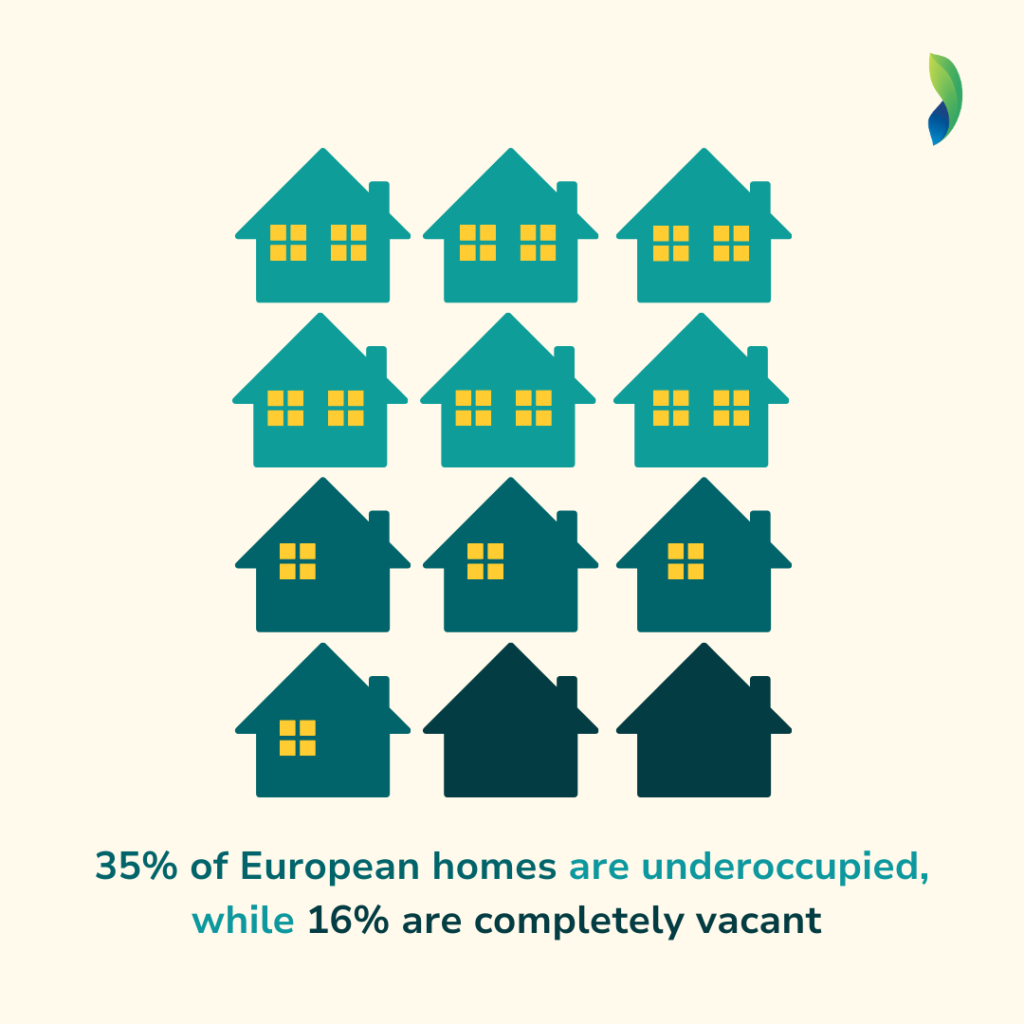
3. Make better use of what we already have. 47 million homes stand empty in Europe while others are overcrowded. Renovating and repurposing existing buildings is faster, cheaper, and more sustainable than new construction. The EU should track long-term vacancies, incentivise retrofits, and avoid urban sprawl. France’s Plan to Combat Vacant Housing combining a centralised database and support to municipalities shows that actions to tackle vacancies can be taken on a large scale.
4. Ensure a socially fair energy transition. Renovations must help, not displace, low-income households, as well as foster community ownership approaches. Funding, tenant safeguards, and rent protections are critical to avoid energy upgrades from worsening inequality by preventing renovictions or rent increases. Funding mechanisms should prioritise the worst-performing buildings and provide up-front financial and technical support for vulnerable households, and citizen-led not-for-profit renovations. Social safeguards, such as rent controls, transparent savings assessments and tenant participation, are essential to ensure that renovation programmes reduce, rather than deepen, inequalities. For many young Europeans locked out of homeownership and facing high rents, this will also determine whether they can build stable lives in their communities.
5. Treat housing as a right, not an afterthought, in the broader EU policy frameworks. EU fiscal rules and market frameworks often block public investment. The Commission must align economic governance with social needs to ensure the right investments in housing can be made.
Europe’s housing crisis is a choice, not our destiny. The crisis today is the result of choices that prioritised markets over people, and short-term construction targets over long-term resilience. If the Affordable Housing Plan fails to address structural problems, it will merely deepen our social cracks. We need bold, citizen-centered solutions that guarantee affordable and sustainable homes for all.
Affordable housing should be Europe’s next social contract – fair, sustainable, and non-negotiable.