


The Chornobyl disaster was a turning point, not only for Europe’s energy debate, but for a generation of activists. In this article, EEB President, Toni Vidan reflects on the origins of grassroots environmental campaigning in former Yugoslavia and the lessons it holds for today’s energy transition.
In the mid‑eighties, I was a mechanical engineering student dreaming of a future working on merchant ships or building nuclear plants in far‑off countries. Like many others, I felt a growing dissatisfaction with the one‑party system and its inability to build a society based on merit rather than loyalty. To express that frustration – and to have some fun – I joined an informal group called TTB, which organised occasional pro‑democracy stunts. One of them, a ‘silent demonstration’ on Zagreb’s main square in 1985, ended up mentioned in The Economist, which filled us with pride.
Before Chornobyl, the first nuclear power plant near Zagreb, located in Slovenia, had already been built, and there were ambitious plans for more. Although there was sporadic public criticism and a sense that people were not enthusiastic about nuclear expansion, the prevailing belief was that the program would continue because the regime and its experts supported it.
Then Chornobyl happened. In Zagreb, we had an independent and very popular youth radio station, and a courageous expert from the public health institute warned listeners early on to stay indoors, avoid the rain and skip fresh garden vegetables. We did not yet know what had happened, but we sensed that something truly serious and significant had occurred.
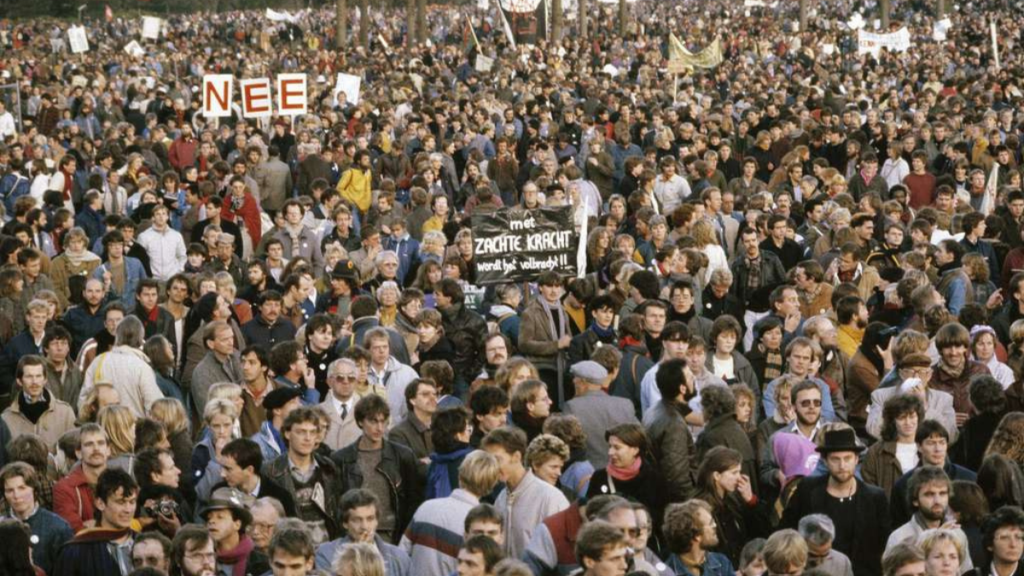
By then, our informal pro‑democracy group had become slightly more organised, and we called ourselves “Svarun”, a Slavic deity associated with light and fire, awakening and creation. Immediately after the disaster, we decided to launch an anti‑nuclear campaign in Zagreb and soon began cooperating with friends in Slovenia. We joined the first demonstrations triggered by Chornobyl on 10 May in Ljubljana, where several hundred people gathered. Over the next year, multiple local anti‑nuclear initiatives emerged in Ljubljana, Zagreb, Belgrade and in regions where new nuclear plants were planned, mainly along the Danube and Sava rivers and on the island of Vir on the Adriatic coast.
Our campaign in Zagreb is now considered the first genuine environmental advocacy campaign in Croatia carried out by an organisation independent of formal institutions. We set up a stand, produced and sold badges, collected signatures for a petition calling for a moratorium on nuclear construction and organised public debates. Our arguments against nuclear power culminated in April 1987 with the publication of a 50‑page brochure written by our member Zoran Oštrić.
All these campaigns, combined with widespread public opposition, eventually led to official moratoriums on nuclear construction, first at the republic level in Slovenia, and later at the federal level in Yugoslavia.
The experience of the Chornobyl catastrophe, and my involvement in that first campaign, changed my life profoundly. I was shocked by how little respect many experts had for public opinion. Their unwillingness to consider negative externalities, risks and long‑term impacts was deeply disappointing. I remember struggling to explain the “soft energy path” based on efficiency and renewables because I could not yet describe how such a system would function in practice. Still, we felt strongly that enough technology already existed to begin the transition and that solutions would emerge along the way. We felt it in our bones, as some would say.
Most of my technical doubts disappeared during my first seminar at the Danish Centre for Renewable Energy, the Folkecenter, in the summer of 1990. There, I visited Vestas and saw wind turbines being produced in a real factory. From that moment on, I became a full‑time energy campaigner, a path I followed for the rest of my life. Unfortunately, my non‑technical dilemmas were never resolved, and as you can imagine, they have only intensified in recent years: while we have all the technical solutions at hand and renewables have become the cheapest and safest source of energy globally, the push for both a return to fossil fuels and for more nuclear is real.
The campaigns triggered by Chornobyl shifted the course of several countries to move away from nuclear. Today, we have the potential to shift away from both nuclear and fossil fuels, and to shift the course of Europe to energy independence and long-term sustainability.