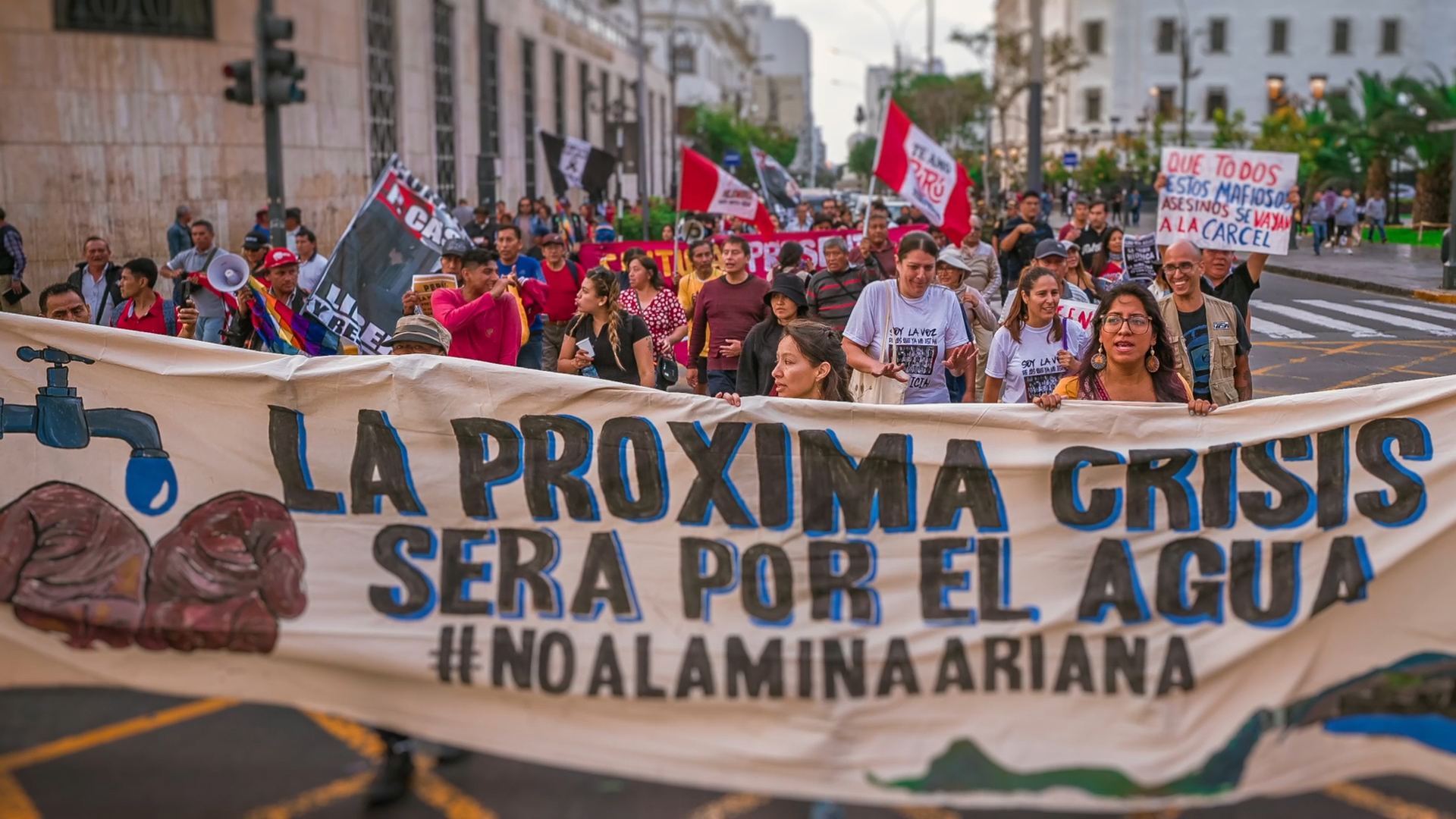
The EU has branded Peru a reliable, like-minded supplier of the copper its energy transition demands. But high in the Andes, a single mining project reveals the dark side of this alliance. Directly beneath the proposed mine lies the water tap for a metropolis of 11 million people, and it is hanging in the balance.
Photo: CooperAcción
Copper is one of the most sought-after materials on Earth and the backbone of modern industry. For every 1% of global GDP growth, copper demand historically grows by roughly 1.2%, as it is the indispensable metal behind global construction, electronics, manufacturing machinery, and transportation. Today, its role is expanding further as the world scales up renewable energy and pursues economic growth, with copper carrying energy currents through every wind turbine, solar inverter, electric vehicle, and high-voltage transmission line.
The EU is already the second-largest consumer region with around 15% of global refined demand, and is further racing to build “supply security.” Yet copper’s future demand is truly unprecedented. According to the International Copper Association, EU copper demand will rise by around 35% between 2020 and 2050. Put another way, the amount the world will seek by 2050 will surpass all copper mined throughout human history.
Beyond renewable energy, copper is increasingly critical for defence, aerospace, and the AI-driven data-centre boom, three sectors the EU has identified as central to its growing competitiveness and security agendas. Given that the bloc produces only a fraction of the copper it demands, it is now actively forging international partnerships to ensure reliable access to this malleable and conductive material.
The open veins of the Andes
Of the 34 critical raw materials on the EU’s list, 25 are extracted in Latin America. For copper ore specifically, the region remains the dominant source for European smelters, supplying roughly three-fifths of the bloc’s imports. Peru is emblematic of this dependence, as it ranks as the world’s third-largest copper producer and the EU’s second-largest supplier of copper ore and concentrate, behind only Brazil.
The two ends of this trade meet at 4,500 metres above sea level in the Peruvian Andes. On a windswept plateau of lagoons, peatlands and wetlands sits the entrance to a tunnel that Peru’s capital could not live without. The Cuevas-Milloc trans-Andean tunnel, bored through the central Andes in the early 1960s, pierces the watershed divide between the Mantaro and Rímac basins and carries Andean meltwater west, into the rivers that feed metropolitan Lima.
For nearly a decade, a coalition of Peruvian citizens, NGOs, the water workers union, lawyers and former government officials has tried to stop an underground mine proposed by Alpayana S.A.C. in the Marcapomacocha district of the Junín region in the Andes. The project’s planned operations would sit practically on top of the tunnel that, during the dry season, supplies roughly 60% of the drinking water consumed by more than 11 million people in one of the largest desert cities on Earth.
What’s even more concerning is that the proposed tailings dam would be located in an area of known seismic activity. In recent decades, earthquakes have caused around 65% of historical tailings dam failures in Peru.
Naturally, the threat to Lima’s primary water supply has triggered alarms.
A river under siege
SEDAPAL, the capital’s state water utility, warns that the mine could disrupt groundwater flows, introduce heavy metal contamination, and compromise the tunnel’s structural integrity through blasting vibrations. Although the project has secured an approved Environmental Impact Assessment (EIA) and a reported $200 million investment plan, SEDAPAL and the coalition of legal experts have repeatedly challenged its economic justification.
Even before the Ariana mine begins operations, the Rímac basin is profoundly degraded. Research by Peruvian civil society groups Red Muqui, CEAS, and the Diocese of Chosica reveals that the Rímac River, Lima’s primary water source, is already heavily contaminated. Edwin Alejandro, a water quality researcher for Red Muqui, notes that the basin is buckling under historical neglect, setting a dangerous baseline before the mine even starts extracting
Sediment analysis has revealed toxic elements exceeding Peruvian Environmental Quality Standards by alarming margins, with dangerous concentrations of arsenic, cadmium, and lead. To put that in a European context, the levels of cadmium found in the Rimac River are up to 20 times higher than the strict limits legally permitted in EU tap water, and 500 times the EU benchmark for surface rivers.
Meanwhile, arsenic levels were detected at 203 times the permitted limit, a staggering figure, given that Peru’s drinking water standard for arsenic aligns perfectly with the EU limit of 10 micrograms per litre. Yet, the mining sector is not the only one to blame, as textile industries and thousands of other contamination sources also compound the crisis.
For Alejandro, the threat of the Ariana mine, which acquired the site from mining company Southern Peaks just two years ago, is not a hypothetical future disaster. It is the exacerbation of an ongoing ecological crisis.
“The state has a great responsibility. In 2025, President Dina Boluarte announced that we would recover the Rímac River. That came only because of intense social pressure. But it is just a speech. We need a territorial planning policy, though what exists has been crafted in a framework that prioritises economic interests.”
Edwin Alejandro, a water quality researcher for Red Muqui.
European money, European silence
Ariana is not on the EU’s Critical Raw Materials Act list of Strategic Projects. It is not the subject of a Strategic Partnership memorandum, and the EU has no official CRM partnership with Peru, despite Peru being one of the world’s largest copper producers.
However, European policy increasingly speaks of Peru as a “like-minded” supplier, a reliable partner from which copper can flow without the geopolitical anxieties of cobalt from the Democratic Republic of the Congo or rare earths from China. The implicit message is that copper from places like Peru is somehow cleaner, environmentally, socially, and politically than copper from elsewhere.
The lifeblood of the Ariana project does not just come from the Andes; it comes from the heart of Europe. Banco Santander, the Spanish banking giant, has been providing loans to Alpayana. On paper, Santander is a champion of sustainable finance. It is a member of the Equator Principles, a risk management framework adopted by over 130 financial institutions globally, which explicitly requires banks to ensure that the projects they finance do not severely violate the human rights of local communities. Santander’s own Responsible Banking and Sustainability Policy commits the bank to respect the human right to a clean and healthy environment.
When, in May 2026, the Peruvian NGOs CooperAcción and Red Muqui formally alerted Banco Santander to the severe, documented threats the Ariana tailings dam poses to the drinking water of 11 million people, the bank’s response was telling. Citing “client confidentiality,” Santander refused to disclose the specific terms of its financing. It promised, however, to share information and monitor the situation if “anything happened.” A month has already passed.
No more claiming ignorance
The European institutions championing the energy transition, and the banks financing it, can no longer claim ignorance. Under the EU’s newly adopted Corporate Sustainability Due Diligence Directive (CSDDD), large European companies and financial institutions are obligated to identify, prevent, and mitigate adverse environmental and human rights impacts in their operations and value chains.
The Ariana case shatters the EU’s narrative of “like-minded” sustainable partnerships. Here is a project that Peru’s own state water utility (SEDAPAL) vehemently opposes, and that constitutional courts have recognised as an imminent threat to the drinking water of eleven million people. Yet, the Peruvian state continues to advance it, even pushing legislative reforms that threaten to criminalise and restrict the very NGOs defending the watershed.
There is a second strain flaw in the story. The “sustainable copper” narrative almost always rests on the assumption that Europe needs far more of it to electrify. That assumption is increasingly contested. The French association négaWatt, in its 2025 study Le Cuivre, models EU copper demand under a sufficiency-led pathway and shows that primary copper requirements can be brought down substantially through “sobriété” (sufficiency), substitution, environmental efficiency and recycling. Demand control, the report argues, is itself a lever of resilience, directly challenging the framing that supply must rise to meet whatever demand the energy transition and other industrial sectors project.
The demand side cannot be left out of the conversation. Peru’s eleven million Limeños did not consent to be the marginal supplier of European electrification. The least the EU can do, while it figures out partnerships and projects and supply chains, is to take seriously that every tonne of copper not used is a tonne not extracted, and a watershed somewhere left intact.
Ariana is not yet operating, so its eventual copper buyers are unknown. But Peru ships nearly all its concentrate to Asia, with Germany the only EU buyer of meaningful size, and Aurubis its main European customer. If Ariana goes through, that copper will find its way to smelters, likely in Europe.
Yet in Marcapomacocha, the lagoons keep flowing into the tunnel, for now.
Take action: tell Banco Santander to stop financing the Ariana mine and protect the drinking water of 11 million people. Sign the petition.