🫂 We are back, and we have missed you!
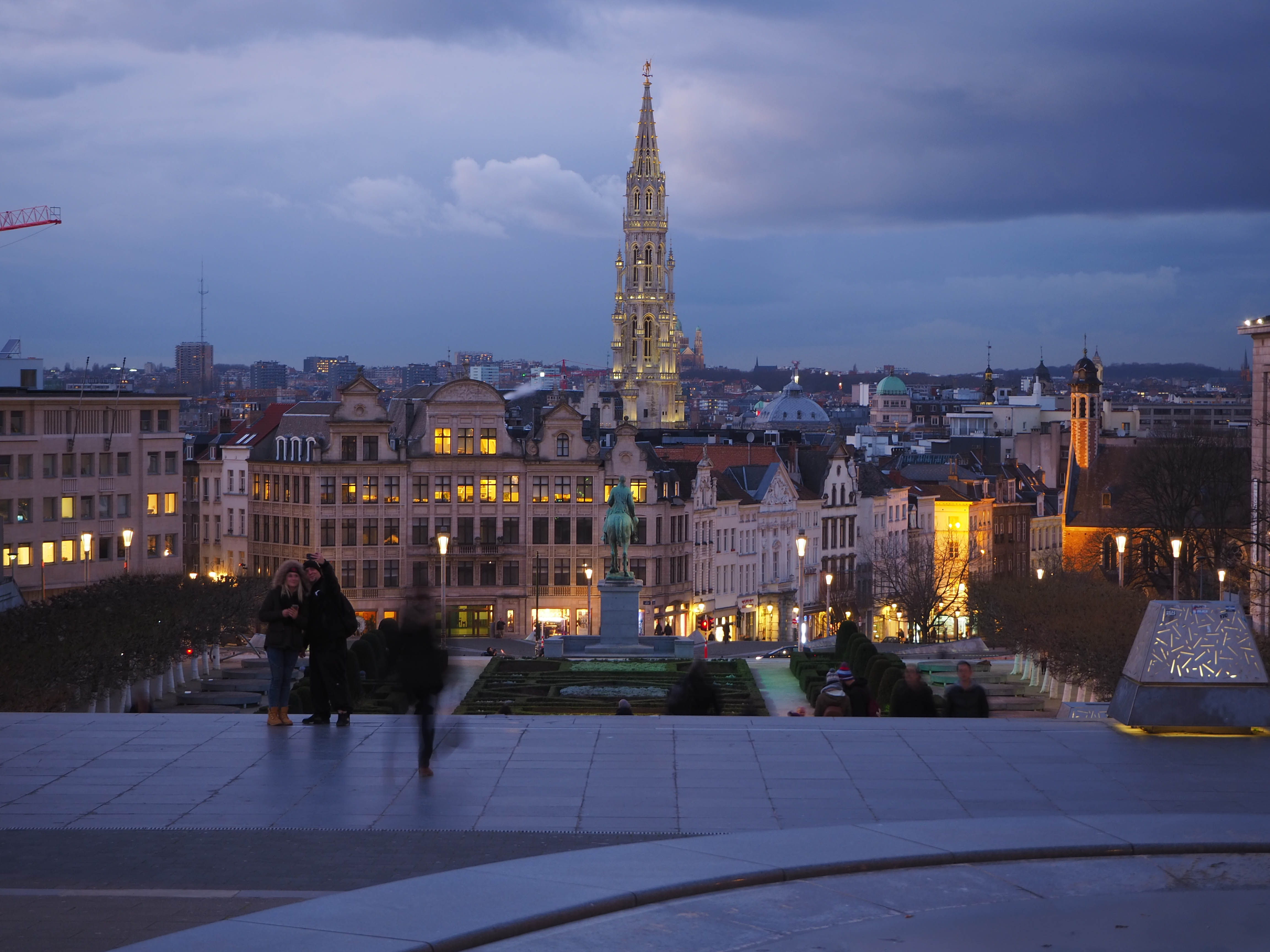
The out-of-office replies are disappearing. Brussels is back to work. And the latest talk of the town – and alleged answer to Europe’s competitiveness problems – has a curious name: the Rhine Group.
Launched this summer and co-founded by Mario Draghi, the former President of the European Central Bank, it brings together leaders from business, finance, technology and beyond to push Europe to move faster on competitiveness.
Meanwhile, the actual Rhine River has been sending Europe a rather different message.
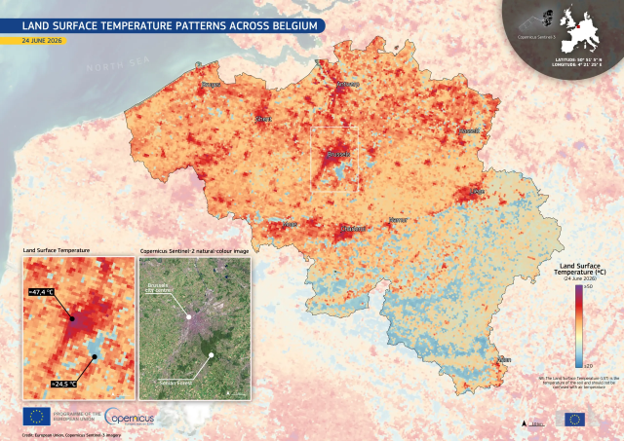
Water levels fell close to historic lows this summer, disrupting shipping and industrial production along one of Europe’s busiest trade routes. Elsewhere, it was also HOT. Heatwaves, drought and wildfires claimed lives, destroyed homes and left crops in ruin. Another geopolitical crisis is still sending fossil fuel prices soaring.
Quite the summer… And quite the reminder that an economy doesn’t exist independently of the physical world. Clearly, it is hard to simply simplify our way out of a drought.
Yet somehow Brussels risks returning to exactly where it left off: debating which environmental safeguards to reopen, which protections to make more “flexible”, and how much more simplification Europe needs to compete.
And yet the rentrée is already moving. In less than two weeks, President von der Leyen will deliver her State of the European Union address, and from what we hear, climate might be an important part of it. So perhaps the main question for this rentrée is whether Europe has learned anything from the summer we’ve just had.
While usually the editor, it’s Chris holding the pen this week, and here are five questions worth watching this week:
- ⛽ Will Europe make this fossil fuel crisis its last?
- 💰 Who will pay to climate-proof Europe?
- 💸 Will Europe’s budget match the threats it faces?
- ♻️ Will circularity become an industrial strategy?
- 🌳 Will Europe invest in the nature it depends on?
☕ As always, if you enjoy reading this newsletter, consider buying us a coffee to support our work. Thaaaanks
⛽ 1. WILL EUROPE MAKE THIS FOSSIL FUEL CRISIS ITS LAST?
Fool me twice… Europe is living through its second major fossil fuel crisis in four years. Last year, the EU spent €340 billion on fossil fuels. Once again, someone else creates the crisis, and Europeans get the bill.
But Europe can’t solve climate change alone! True. All the more reason to reduce Europe’s fossil dependence, not maintain it. Europe can’t control what Washington or Beijing decides, or global oil and gas prices. What it can control is how exposed it remains to them.
A big part of the answer: renewables, electrification and efficiency. During the first 16 weeks of this year’s fossil-price crisis, renewable electricity saved Europeans an estimated €29 billion.
Don’t get left behind. China’s electricity generation grew by around 500 TWh last year – roughly Germany’s entire annual electricity production – with almost all of that increase coming from wind and solar. While Europe debates the transition, others are busy building it – and reaping the benefits.
Time for the Draghi treatment. Ahead of the State of the European Union,more than 200 organisations and associations, including industry, want an independent roadmap to end Europe’s fossil dependence and use: what is this dependency costing us, and what’s the fastest, fairest, and cheapest way out?
👉 Read our letter to President von der Leyen here.
💰 2. WHO WILL PAY TO CLIMATE-PROOF EUROPE?
Something interesting is happening here. Germany, Spain, Italy, Austria, Poland and Portugal want EU finance ministers to discuss taxing oil companies’ crisis profits at their meeting later this month.
And this week, Executive Vice-President Teresa Ribera pointed to the elephant in the room, saying Europe needs to consider more ambitious ways to pay for climate resilience – including a bigger EU budget, more common borrowing, and taxing big oil.
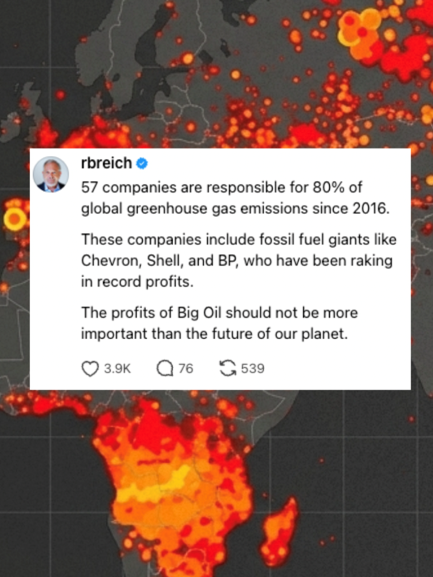
Climate-proofing Europe will cost hundreds of billions. Meanwhile, eight of the world’s biggest oil and gas companies made almost $93 billion in profits in just three months this year.
Crisis for you, sky-high profits for them. Asking those profiting enormously from the fuels driving the crisis to help pay for resilience seems a pretty reasonable place to start.
💸 3. WILL EUROPE’S BUDGET MATCH THE THREATS IT FACES?
Not everyone got the memo. On Monday, a majority in the EU Parliament’s Industry Committee backed removing the proposed target of spending 35% of the next EU budget on climate and the environment (an advisory, non-binding opinion). The amendment, supported by the EPP and most far-right and ultra-far-right MEPs, would replace it with a competitiveness spending target – and also remove the principle that EU spending should “do no significant harm” to the environment.
The timing is quite something. This week, the UN announced that the world is set to cross 1.5°C of global warming, but can still limit, adapt to and return from higher temperatures. Similarly, Commission top brass has stressed Europe’s need for more collective investment in climate resilience.
And then there’s LIFE. The Commission’s proposal, as we know, would also end LIFE as an independent programme in the next EU budget. For 30+ years, LIFE has turned European environmental ambitions into reality: restoring nature, tackling pollution, adapting to climate change, supporting the clean energy transition and helping civil society to uphold environmental and health protections. If we are serious about the future, we must stand with LIFE and fund environmental action.
♻️ 4. WILL CIRCULARITY BECOME AN INDUSTRIAL STRATEGY?
Europe has another dependency problem. Our economy consumes vast amounts of raw materials, many of them imported, while wasting far too much of what we already have.
The upcoming Circular Economy Act, with the Commission’s official draft expected this autumn, is a chance to change that: make products last longer, keep valuable materials circulating and reduce Europe’s dependence on virgin resources and vulnerable supply chains.
Important reminder. Circularity starts before the recycling bin: prevent waste, use fewer resources, make things that last. In a world of growing geopolitical and resource pressures, that’s not just sound environmental policy. It’s industrial resilience and strategic autonomy.
🌳 5. WILL EUROPE INVEST IN THE NATURE IT DEPENDS ON?
This week, nature restoration got real. Monday was the deadline for Member States to submit their draft plans for implementing the Nature Restoration Law. After years of squabbling over the law, Europe is finally about to… actually do it! The Commission will now assess the plans and discuss their finalisation with governments.
Start asking the right questions. Brussels spends a lot of time asking what restoring nature might cost farming, forestry or industry. But what does not restoring it cost? What happens to farmers during drought? To industry when rivers evaporate? To workers during extreme heat?
Nature is our safety net. Forests cool landscapes, wetlands store water, healthy soils support food production, and functioning rivers reduce flood risks. These aren’t nice-to-haves. They help Europe protect its economy and communities from increasingly deadly climate extremes.
And yes, Europe needs to adapt. But adaptation has limits. Ecosystems cannot turn on the air conditioning. Neither can everyone in Europe. So, while some in Brussels are considering reopening laws like the Water Framework Directive – at precisely the moment drought and water shortages are demonstrating why we need them – have you tried implementing them instead?
🔔 SO, HAS EUROPE LEARNED ANYTHING?
There will be plenty of reasons offered this autumn for why Europe shouldn’t do all this. Too expensive. Too burdensome. And inevitably: what difference does it make if Europe acts when the rest of the world doesn’t?
Europe cannot solve the climate crisis alone. But it can decide how vulnerable it wants to remain. Import fewer fossil fuels. Make polluters pay. Invest in resilience. Use resources more intelligently. Restore the nature protecting us.
The Rhine Group is asking how Europe can become more competitive. Perhaps the Rhine itself is asking the more important question: Competitive in what kind of world?
Welcome back.
🧠✨ DOPAMINE HIT
As ever, here are a few happy updates to get your weekend off to a perky start:
- Otter spotted for the first time in 100 years in New York City’s Bronx River. Read more here
- Germans could save over €12,000 by ditching gas boilers for solar, battery and heat pump. Read more here
- Solar cuts ‘at least £400 from bills in even the cloudiest British areas. Read more here
- WHO Declares Uganda Ebola-free After 42 Days Without New Cases. Read more here
🧚 THE JOB FAIRY
- Médecins du Monde is looking for a Health Promotion Officer
- Institute for European Environmental Policy is looking for a Communications Officer
- ClientEarth is looking for a Head of People and Culture
- European Institute of Peace is looking for a Finance Officer
📢 ORGANISE
If you are not involved, get involved.Find a member organisation near you.
🚀 FOLLOW US
Don’t stay delulu, deal with the pollulu 🍃✨ Stay connected with us on LinkedIn, Bluesky, TikTok, Instagram, and YouTube. Don’t miss out!
Are you a journalist?Subscribe here to stay up to date on our latest European environmental policy updates made specifically for you!
We have opened a new mailbox for your tips and tales from the ground. Got something you think we should feature? Reach out to us at newleaf@eeb.org.
✨ SIGN UP
Stay informed. Subscribe to our Newsletter by email for the latestEU green insider updates every Friday morning and to support our work. By subscribing, you also get early access to our in-depth analysis of key EU environmental policy.
By: Christian Skrivervik. Special thanks to the EEB’s editorial team: Ben Snelson and Roi Gomez.