Good morning, superstar!
If you are reading this, it means that you made it through the 10 darkest weeks of the year, and from now on its only days getting longer bit by bit and the promise of warmer temperatures on the horizon!
In this edition, we try to answer all these questions, and more!
- Is there room for a politics of hope in 2026?
- Can Europe afford forever chemicals?
- Can the End-of-Waste criteria boost the circular economy?
- Can we ask you on a date?
To support our work, consider buying us a coffee ☀️
💊 MAKE HOPE NORMAL AGAIN
Why are Europeans so gloomy?A new report indicates that Europeans have the blues. It seems we hold a broadly pessimistic view across most issues – particularly the state of our democracies, the integrity of traditional institutions and the willingness of our governments to address the major concerns and challenges faced by regular people.
Am I depressed, or is my rent too high? The cost of living continues to rank as the top concern across age groups and political divides. A strong majority believes that big businesses and high earners should shoulder a greater share of the burden.
As much as 74% say that the political system favours powerful elites, and 64% back the introduction of a wealth tax on those few at the very top. Key takeaway: far from being marginal views, these opinions reflect prevailing attitudes across democracies in Europe and beyond.
Perhaps that helps explain why this video showing how to make hope normal again by Zack Polanski, leader of the UK Green Party, spread like wildfire across Europe on social media. Apparently, by describing how “good leaders put people before profit,” Polanski touches upon an issue that clearly resonates with millions of people across ages, borders and political affiliations.
Fresh Outta Davos – Just in time for the meeting of the world’s elites in Switzerland last week, the World Economic Forum published its annual Global Risks report, an analysis of the biggest threats facing our world in the next two- and ten-year periods.
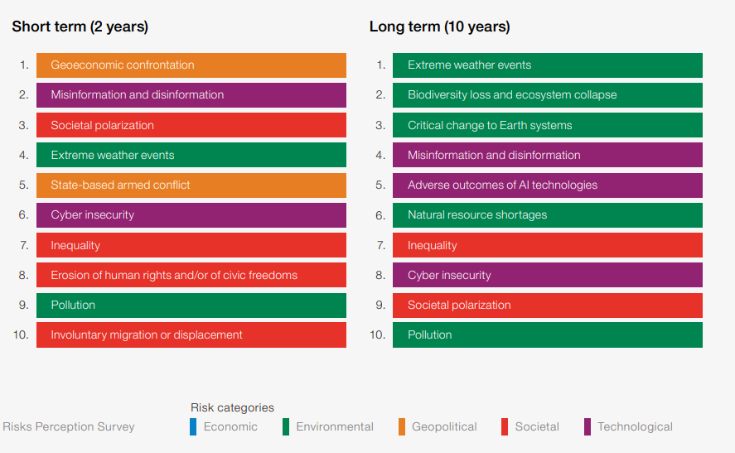
Source: World Economic Forum Global Risks Perception Survey 2025-2026
TL;DR – In the short term, several acute risks emerge, including rising social polarisation, extreme weather events and a deterioration of human rights, among others. Notably, compared to last year’s ranking, “geoeconomic confrontation” has surged to the top of the list, pushing “mis- and disinformation” into second place. Intentional or not, it has been assigned the colour orange – inviting some unmistakable associations.
Let’s not forget – Looking further ahead, over the next decade, environmental risks dominate the outlook of the Davos elite, including experts from academia, business, government, international organisations and civil society. Extreme weather, biodiversity loss and major disruptions to Earth’s systems are seen as the most serious threats. Nearly three-quarters of respondents expect an unstable or turbulent environmental future.
FROM NYC WITH ❤
007’s newest mission? The climate crisis is now officially recognised as a national security risk in the UK. This conclusion comes from a new report by the Department for Environment, Food and Rural Affairs, produced in collaboration with MI5 and MI6, the UK’s intelligence agencies.
Shaken, not stirred – According to the report, the impacts of biodiversity being destroyed are already evident, including crop failures, increasingly severe natural disasters, and the spread of infectious diseases. Without major intervention, the warning is clear: environmental degradation will only intensify these risks, becoming a major security issue for the UK.
The end of the end of history – As we approach the end of the first month of the year, it is increasingly clear that – despite any preference for reading about history rather than living through it – we are in a moment that future generations will study. This is an era in which they will ask: what did you do? Or perhaps more pointedly: why did you do nothing?
Did you not see – that greedy billionaires and their corporations were attempting to seize ever more power? Did you not understand that what most people wanted was far simpler: a good, dignified and affordable life, and a government that works to solve their problems rather than become one? Anything else feels… so 2008.
Old news – None of the many challenges facing our democracies can be solved by rolling back the laws that protect us or by placing blind faith in the “invisible hand” of the market. That era is over. Our take: leaders who still argue otherwise are either masking inaction or trapped in last century’s ideological cages.
People want a vision – Give us governments, at regional, national and EU levels, that come with solutions, not excuses. In a world of growing uncertainty and instability, we would rather see leaders rolling up their sleeves and trying to fix the problems we face than standing still.
Think long term – We need strategies fit for a world defined by long-term challenges, not short-term fixes. That means ambition and political courage: using the full capacity of government to tackle the defining crises of our time – climate and ecological breakdown alongside a deepening cost-of-living crisis.
Live from NYC – The lead campaign strategist for New York Mayor Zohran Mamdani visited Brussels this week, speaking to a captivated audience that included several members of the EEB team, on how one of the most effective and relentlessly on-message campaigns in recent years was run. The key takeaway: the power of leading with hope and joy in both politics and policy – and the reminder that there is no challenge too big to solve.
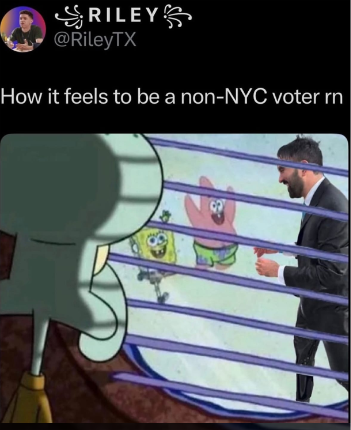
Videos and memes celebrating Mamdani’s win spread rapidly online, many outside the US, reflecting global appetite for hopeful, policy-driven leadership.
Cities do it better – While national governments seem obsessed with rolling back protections for people and planet, some cities are showing that local ambition can still deliver. In a previous edition, we took a look at some of the cities offering us a pathway of hope.
⚗️ CHEMICAL CORNER
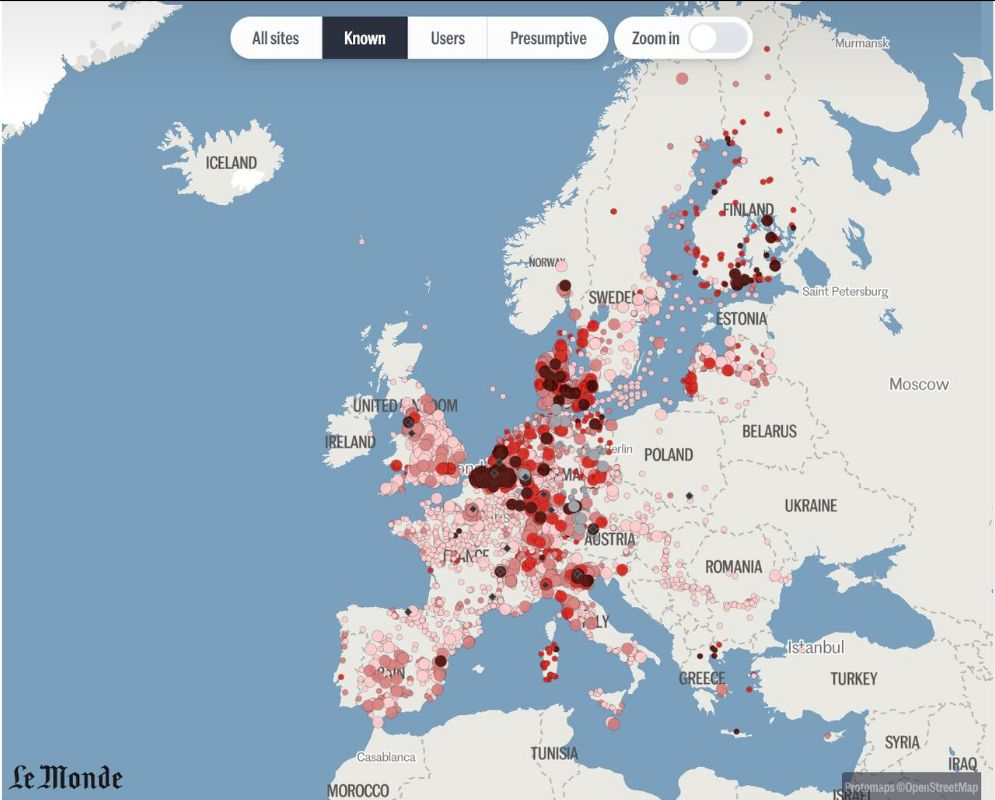
The cost of pollution – This week, the EU Commission published a report laying bare the societal costs of PFAS pollution. It examines three core areas: the impacts of four PFAS substances (so-called “forever chemicals”) on human health; the soaring costs of cleaning up contaminated soil and water; and the damage to ecosystems.
The message is hard to ignore. The EEB welcomes the report, which reinforces earlier findings, including those from the Forever Lobbying Project: continued inaction could cost society up to €1.7 trillion by 2050. Allowing PFAS pollution to continue is not only a public health failure – it is an economic one. Stopping PFAS at the source is the only credible way forward.
Hold polluters accountable – Who should pay? For what? And how much? For too long, the answer has been: the public. People like you and me have paid with our health and our wallets, while polluters walk away. In a new briefing published by the EEB together with the Observatory of the Polluter-Pays Principle, ClientEarth and CIEL, we show how this can change.
Look for yourself – The briefing sets out practical steps to apply the Polluter-Pays Principle to the PFAS crisis, backed by a concrete case study that gives policymakers a clear roadmap for action. The tools exist. The evidence is there. No one can say they didn’t know.
🗞️ IN OTHER NEWS
As good as new – The EU wants to boost the circular economy. How? By scaling up the use of waste-derived materials, or ‘secondary raw materials’. This means new products should preferably be made from recycled materials to reduce the extraction of primary materials.
Waste not, want not – To make this happen, the Commission proposed an “End of Waste criteria” for turning recycled plastics from waste into products, but its plan is flawed by critical gaps, especially when it comes to chemicals that can harm our health and the environment. We provided this briefing in case they need inspiration.
Be like water, my friend – The River Neris carries more than water. Flowing through a protected Natura 2000 landscape and one of the last Baltic salmon migration routes, it is now drawn into Europe’s security and energy debates. Guest contributor Olga Karach explores how the river is being forced to absorb nuclear risk and geopolitical anxiety, revealing Europe’s shifting relationship with nature.
Meanwhile, the EU’s Water Framework Directive – our strongest shield for clean water – is under pressure from powerful industry interests seeking weaker protections. It’s time to stand up and uphold these fundamental protections and recognise clean, healthy water as our most vital defence in these uncertain times.
Movie date? 👉👈 Are you in Brussels next week? Are you a nature and/or cinema lover? Would you like to meet us face to face and have a chat? If the answer to any of these is yes, you are invited to the screening of “The Song of the Forest”. Get your tickets here. We look forward to seeing you there!
🧠✨ DOPAMINE HIT
As ever, here are a few happy updates to get your weekend off to a perky start:
- Amsterdam becomes the first capital city to ban fossil fuel and meat ads from public spaces from May 2026. Read more here.
- A Dutch court ruled on Wednesday that the Netherlands violated the human rights of residents of the Caribbean island of Bonaire, a Dutch territory, by failing to protect them from the effects of climate change, calling for immediate action. Read more here.
- In a world where ICE and fearmongering around migrants have become the rule, the government of Spain grants legal status to 500,000 undocumented migrants. Read more here.
- Indonesia takes action against mining firms after floods devastate the population of the world’s rarest ape. Read more here.
- The Bear Smart Landscape Project, which aims improve cohabitation with bears, wins the Defender Awards 2025 prize in Italy. Read more here.
☕ BUY US A COFFEE
From dirty lobbies to smear campaigns, billionaire bullies to climate collapse, we face a lot. Support our work, one coffee at a time.
📢 ORGANISE
If you are not involved, get involved.Find a member organisation near you.
🚀 FOLLOW US
Don’t stay delulu, deal with the pollulu 🍃✨ Stay connected with us on LinkedIn, Bluesky, TikTok, Instagram, and YouTube. Don’t miss out!
Are you a journalist?Subscribe here to stay up to date on our latest European environmental policy updates made specifically for you!
We have opened a new mailbox for your tips and tales from the ground. Got something you think we should feature? Reach out to us at newleaf@eeb.org.
✨ SIGN UP
Stay informed. Subscribe to our Newsletter by email for the latestEU green insider updates every Friday morning and to support our work. By subscribing, you also get early access to our in-depth analysis of key EU environmental policy.
By: Roi Gomez. Special thanks to the EEB’s editorial team: Ben Snelson, Alberto Vela and Ruby Silk. Editor: Christian Skrivervik.