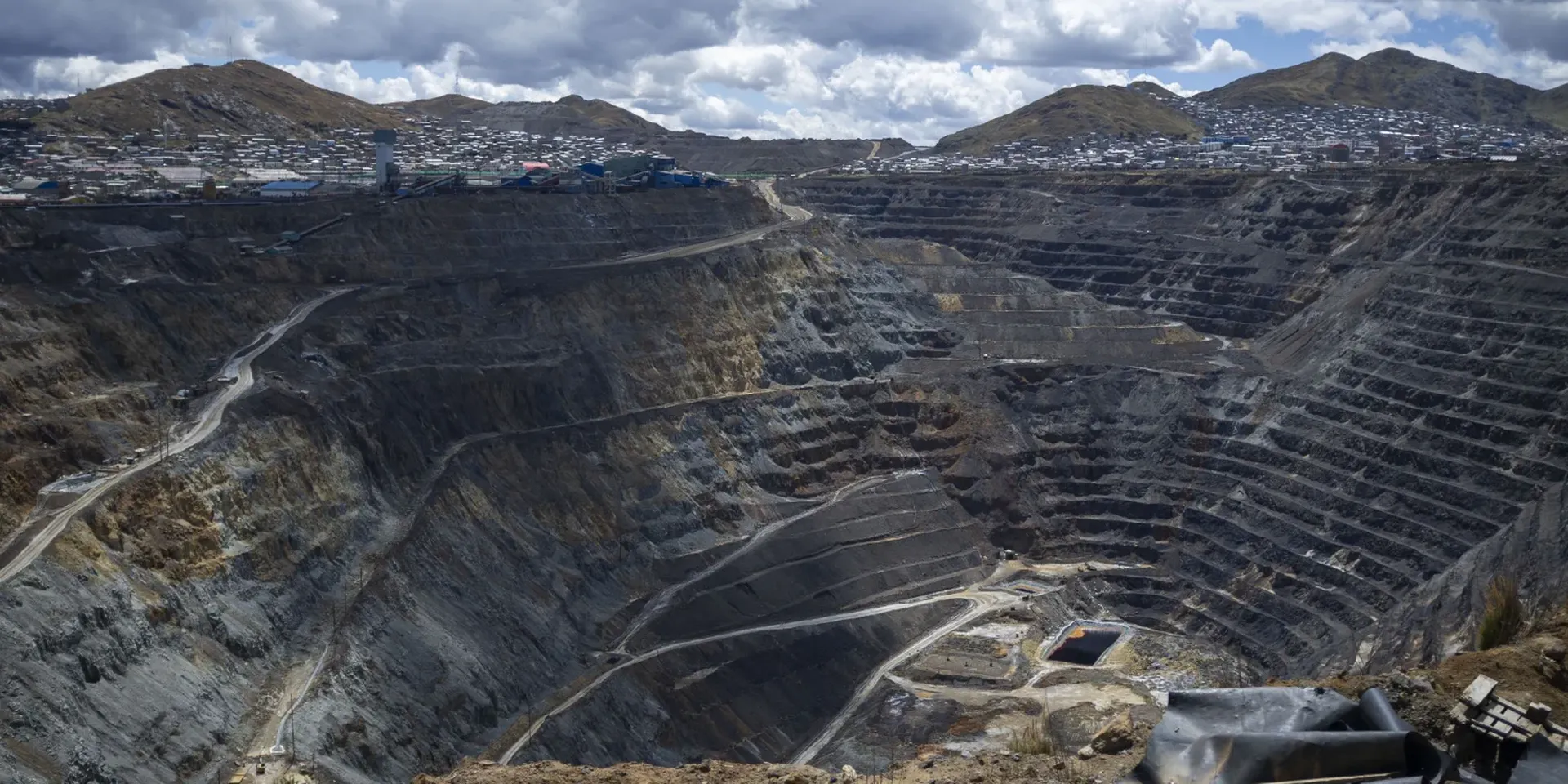
High in the Andes, an open-pit mine has carved a gaping hole in the middle of the Peruvian city of Cerro de Pasco. Each illegal expansion swallows more houses and streets. Residents want the government or the mining company Volcan to finally take action to save their city, or leave the gigantic pit behind.
This article was originally published in MO*.
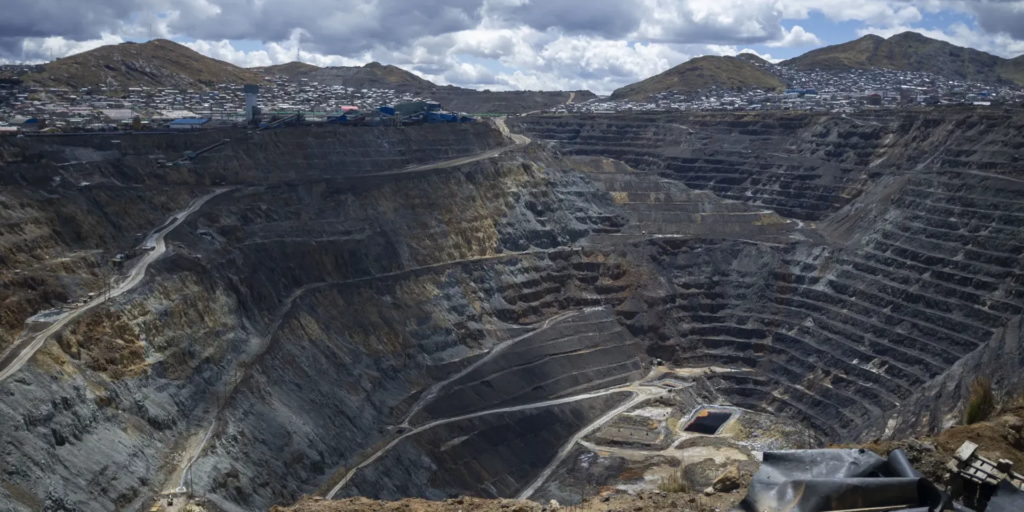
Seen from one of the surrounding hills, the city of Cerro de Pasco is a vast collection of buildings surrounding a gigantic pit at an altitude of 4,380 metres in the Peruvian Andes.
At the edge of that pit stands the house of William Gomez Luis. Or rather: its ruin. Where William once played football as a toddler, we now see a wall, behind which lies excavated ground where trucks drive back and forth. In his new home, elsewhere in the city, William shows us the painting he made of the square.
Further into the city, large residential blocks loom into view. There, Deysi Colqui Quiroz welcomes us while the meat for lunch is already simmering in the pan. She would have preferred to prepare trout for us. “But the trout comes from the polluted Pun Run lake, so I brought meat from the market instead.”
A few streets away, teacher David Daga Rivera stands in front of his class. “In Cerro de Pasco, we do mining.” David is discussing the advantages and disadvantages of mining with his fourth-grade pupils. “What do we have in the middle of our city, girls?”
“El tajo abierto,” the open pit, the pupils reply in chorus.
Above and below ground
The pit around which Cerro de Pasco expands descends in terraces towards the centre and is called Raúl Rojas. It is two kilometres wide and more than 600 metres deep. The colours of Raúl show all the minerals that have been extracted there over the past decades: silver, copper, gold…
It is a landscape that would leave the average European open-mouthed. But for the more than 67,000 inhabitants of Cerro de Pasco, it is the most normal thing in the world.
The district where Deysi lives and where David teaches is called San Juan Pampa. That neighbourhood is referred to as the new part of the city, because it was only built after the open-pit mine. William’s old house is located in Ayapoto, a district that has now been entirely bought up by the mining company.
Cerro de Pasco also has a long history. It is believed that the Incas were already searching for silver, copper, lead and gold in the Pasco region. In the 17th century, according to legend, a shepherd discovered silver veins when he took shelter in a cave from the harsh weather. For the Spanish colonisers, it long remained one of their most important mining areas.
Alongside the development of mining in the region, the city of Cerro de Pasco also developed over the past four hundred years.

However, it was only from the 1950s onwards that mining in Cerro de Pasco shifted to open-pit extraction. Since the American Cerro de Pasco Copper Corporation industrialised the mine, it has often changed ownership. “At the time, foreigners brought us something good, but things went wrong during privatisation under President Fujimori,” says William, who was born and raised in the city.
Under the neoliberal rule of Alberto Fujimori in the 1990s, Peru experienced a major wave of privatisation. After a short period of nationalisation under the state company Centromin, the mine in Cerro de Pasco was sold in 1999 to Volcan, a private Peruvian company.
And in 2011, Volcan transferred the site in Cerro de Pasco to its own subsidiary Cerro S.A.C. “They did that for social reasons,” says Deysi. By this, she means that the parent company shifts responsibility for the harmful consequences of mining in the city onto the subsidiary.
In 2025, according to its own analyses, Volcan extracted 3.5 million tonnes of zinc, lead, copper, silver and gold ore from the site in Cerro de Pasco. Until the year before, most of the revenue reportedly went to the main shareholder, Glencore. But the Swiss giant sold its shares in 2024 to the Canadian Transition Metals, a subsidiary of Argentina’s Integra Capital.
Illegal expansion
“When Volcan bought the mine, they took our water,” William recalls. “But without water and electricity, you cannot stay here. And that is how my neighbourhood, Ayapoto, disappeared.”
He saw the edge of the pit approach the gates of his beloved neighbourhood and the inhabitants leave one by one. “Coming back here makes me nostalgic. My father and mother died here. My friends, neighbours and family have left. There is no one left.”
Until 2024, William still lived with his family in Ayapoto, although the dilapidated houses already resembled ruins more than a neighbourhood. Eventually, he decided to sell his house to Volcan and move to a newer part of the city for the safety and well-being of his wife and four daughters. “When you sell your house, you are really selling your conscience along with the history of Cerro de Pasco. One day, everything will disappear into the pit.”
“Officially, the municipal council has not received a single application for the expansion of the pit for evaluation,” declares Mayor Julio Rupay Malpartida. “But metre by metre, the mining company expands the pit without providing compensation for the public spaces that disappear.”
That is precisely why the municipality has, for example, built a road right next to the pit. It is intended to prevent further illegal expansion at that location.
Relocating the city
As early as 2008, the Peruvian parliament adopted a law declaring the sustainable urban development of Cerro de Pasco to be “of public utility and national interest.”
It outlines plans to tackle pollution, provide healthcare, and enable further development of the city and the surrounding countryside. Because of mining, pollution, and the need for healthcare are greater, and some parts of the city have not been developed because mining companies did not want to invest there.
The law 29293 also prescribes the relocation of the city, further away from the mining pit. The law originated from the parliamentary committee for Indigenous peoples and was, notably, introduced at the request of the population itself.
A commission was tasked, in consultation with the mining company and the government, with drawing up a plan for financing the investments and the relocation. However, the law was never truly implemented. “Relocating a city costs money, but it was never determined who should bear those costs,” says Mayor Rupay. Neither the mining company nor the government wants to pay.
Relocating the city may have seemed like a good idea in 2008, but its consequences were never properly thought through. “Instead of helping the population, this law now works against them.” As long as it remains in force, law 29293 blocks further development of the city. Investing in a city that will be relocated is pointless. “That is why we are currently advocating for an amendment to this law.”
In recent years, several attempts have been made through new legislative proposals. In 2020, for example, a bill was introduced to abandon relocation and instead enable the social and economic revitalisation of the city.
Relocating the city is impossible, says researcher Flaviano Bianchini. Through his NGO Source International, Bianchini has been studying pollution in Pasco since 2008, as well as in other regions worldwide facing similar issues. “Mining has a massive impact on regions all over the world, whether in Peru, Indonesia or Congo. “But if you ask me, Cerro de Pasco is the worst off of all places where mining is a problem.”
That is due, according to Bianchini, to the duration and scale of mining in the Pasco region. The first pollution dates back centuries and is not only felt in the city of Cerro de Pasco, but also in surrounding rural communities.
For example, the water in Lake Quiulacocha is bright red. The seagulls (quiula in Quechua) that gave their name to the community next to the lake (the cocha) have disappeared since the lake became a storage site for mining waste.
Lead in the blood
The conclusion of Source International’s research is clear. The mining company pollutes almost everything it touches: water, soil and air.
Which, in turn, has serious consequences for the health of the population. “From a scientific point of view, there is zero doubt that the mining company pollutes everything. Upstream from the mine, the San Juan River is clean,” Bianchini explains. “Downstream, it is polluted with heavy metals such as lead, arsenic and cadmium.”
“These are exactly the same elements we also find in the hair of people in Cerro de Pasco, and they are the same elements that cause the diseases residents suffer from.”
Those diseases include “kidney problems and haematological disorders” (conditions related to blood and lymph nodes), explains nurse Luis Angel Talavera Reynoso from the local public hospital. “But also muscle and bone diseases, and in some cases, even patients’ eyesight is affected.” Ironically, the building where these patients are treated is located just a few dozen metres from the open pit and Volcan’s headquarters.
Talavera is responsible for everything related to heavy metals. “In the past, it was the high levels of lead in patients’ blood that caused haematological and neurological diseases.” That is why Cerro de Pasco is known as the city of niños con plomo en la sangre, (children with lead in their blood).
“But among the 400 patients we examined in 2022, only 10 to 15 percent still had problems caused by lead.” In the vast majority of cases, the study found, arsenic is now the main issue.
The nurse adds that “in Peru, we do not have the right specialists and laboratories to carry out clinical studies. As a result, we cannot analyse the exact symptoms of heavy metal poisoning.” This means that Talavera and his colleagues cannot provide patients with the appropriate treatment.
They therefore focus mainly on prevention. The best measure families can take is to move to a healthier environment. Some families have followed that advice and left, but for most families in Cerro de Pasco, this is impossible, Talavera admits.
Bad relationship
“There are solutions to clean up the region,” says Bianchini. “But no one wants to pay for them. Not the company, and not the government.”
The government has taken some measures, but nothing that truly offers a solution, according to the researcher. “For example, they have a pollution control plan for the river, and they built a fence around the pit and the waste heaps.”
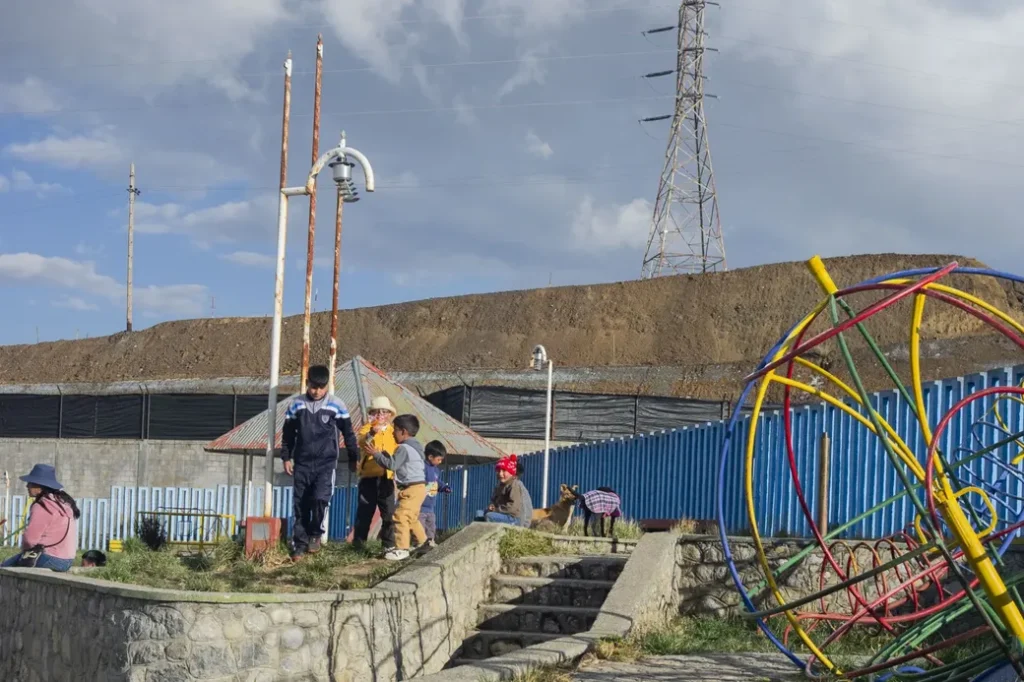
“Politicians repeatedly promise to tackle pollution, but in the end, nothing comes of it,” says teacher David.
No one seems to have real contact with the mining company Volcan or its subsidiary Cerro S.A.C. Despite repeated calls and visits to headquarters, we also received no response from Volcan. Yet on its website, the company states that it is “convinced that environmental management, the health and safety of its employees and meaningful community development are essential to the company’s success and continuity.”
“The relationship between us as authorities and the mining company is bad. It goes so far that we have to take legal action to force the company to comply with environmental requirements, fulfil social obligations and pay taxes,” says Mayor Rupay.
Bianchini, too, has never managed to speak with the company in the 17 years he has been working in Pasco.
Vacancy and unemployment
Because part of the housing has disappeared into the pit, there is now a shortage. Families improvise settlements without public infrastructure in some parts of the city, so-called asentamientos humanos (human settlements). At the same time, the housing built by the Cerro de Pasco Copper Corporation for miners and their families stands largely empty.
In uninhabited apartments, the floors are covered with waste and remnants of past occupancy. In other apartments, the doors have been boarded up by the company. “They do that to prevent people from returning,” says Deysi, as she shows us the apartments next to hers.
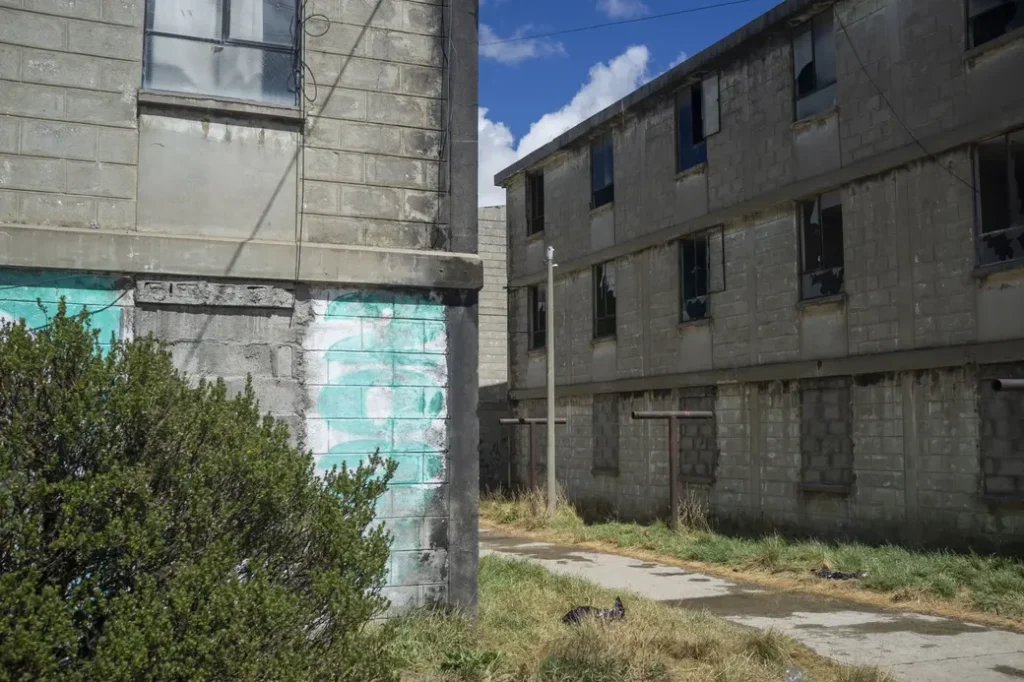
On the outer walls of the apartment blocks, propiedad privada, (private property) is painted, along with the logo of Volcan.
“Living in a company-owned building has its advantages. We do not pay for electricity or water, and we do not have to pay high rent,” says Deysi, whose husband works for Volcan. “But it offers no stability, because of the company’s short-term contracts. It is temporary, each time for four or five months, and after that our fate is in God’s hands.”
The buildings where Deysi and her family live can house around 36 families. Currently, only three remain.
“The mine brings gold, jobs and infrastructure,” say David’s pupils in class. “But the mine also brings bad things, doesn’t it?”
As a teacher and resident, David has seen the city change over the past thirty years: “For my pupils, the mine is no longer an important part of their lives. Most of their fathers now work in trade or as civil servants. Ten years ago, Cerro de Pasco was still truly a mining town. If there were 15 children in my class, 10 would have a father working in the mine. Now, only a few pupils still come from mining families.”
Employment for local workers has decreased significantly because fewer people still receive permanent contracts. Moreover, there is less activity today in the open pit in the middle of the city. Volcan also operates two underground mines and two metal processing plants in Cerro de Pasco – and the latter mainly require specialised workers such as engineers.
The company is also active in other parts of the country, alongside many other mining firms. Deysi’s husband does not work in the Cerro de Pasco mine itself, but at another Volcan site in the region.
As demand for workers has declined, so has the need for housing, and many campamentos – miners’ settlements – stand empty. According to Volcan’s 2024 sustainability report, only 380 people worked at the Cerro S.A.C. mine site that year. Of these, only 198 were from the Pasco region, along with another 140 employees of the parent company, Volcan. The remaining workers were recruited from Lima, Junín and other Peruvian regions.
Volcan also reports employing 737 workers in Cerro de Pasco through specialised subcontracting companies. This means that only a small part of the economically active population in Cerro de Pasco is directly or indirectly employed by the local mining company.
Nevertheless, in David’s classroom, almost all hands go up when he asks who knows someone working in mining, because many people – mainly men – also work at other mining sites and for other companies in the region. Mayor Rupay, however, claims that “the city’s economy would not be affected if the mine were to cease its activities.”
Many Cerreños have already left the cold mountain city for warmer places with better prospects: better education, healthcare, jobs and housing.
Deysi’s family is also considering leaving Cerro de Pasco now that their eldest son has turned sixteen and will begin higher education. Deysi herself would prefer to stay in her hometown, but she sees a better future for her sons in a larger, lower-lying city such as Huancayo or Lima.
Looking ahead
If a referendum were held on whether to close the mine, the population would likely vote to keep it open, David believes. “But only on the condition that the environment is properly protected.”
Mayor Rupay, on the other hand, is convinced that the population would vote for the mining company to leave, or for a more responsible company to take its place.
“I love my country with all its strengths and flaws,” says Deysi firmly. “But I hope there will be greater environmental awareness, so that all this exploitation will not have been in vain.”
David agrees: “Hopefully, one day this city will receive the recognition it deserves for everything it has done for Peru. But history teaches us that cities are exploited and then forgotten. Just look at Potosí. Pasco is now one of the poorest regions of Peru, even though all this mineral wealth has been extracted here.”
We contacted mining company Volcan again for a response to the claims in this article, but received no reply.
This article was produced with support from the Pascal Decroos Fund for Investigative Journalism.