Ifigeneia Tsakalogianni, Environmental Lawyer & Visiting PhD Researcher at the EEB
We have the chance to stop living and breathing pollution, but what is holding policymakers back?
European pollution levels must drop – industrial waste, plastic litter, and chemical runoffs are in the air we breathe, the water we drink, and the food we eat. In Europe, we face a chemical pollution crisis resulting in billions of Euros in health, environmental, and societal costs each year.
The EU has both the mandate and the responsibility to protect human health and the environment. It committed to doing so through the ‘zero pollution ambition’ of the European Green Deal and the 2020 Chemical Strategy for Sustainability (CSS), which set out more than 80 actions to improve the protection against hazardous chemicals, aiming to establish a toxic-free environment in the EU.
The EU Restrictions Roadmap: a promise to clean up the worst chemicals
On 25 April 2022, the European Commission launched what was meant to be a major move to improve our chemical pollution – the Restrictions Roadmap. It is a rolling list of 22 severely hazardous chemicals or groups of chemicals prioritised for restrictions, such as ones that are carcinogenic, mutagenic or toxic to the immune and neurological systems.
Some of the most well-known substances include:
- bisphenols, widely used in plastics, which interfere with the hormonal systems of people and wildlife;
- and PFAS, the toxic ‘forever chemicals’ linked to cancer and disease in the liver, reproductive and hormonal systems of both humans and animals.
The idea was straightforward: speed up restrictions on substances that clearly pose “unacceptable risks” to people and nature through broader restrictions of a wide range of chemical uses, including industrial, professional, consumer uses and uses in articles.
But four years later, the picture is far less encouraging.
Where things stand in 2026: delays, dilution, and silence
- Delays have become the norm, not the exception
Chemical restrictions are often slowed or diluted under sustained pressure from industrial stakeholders. 14 out of the 22 chemical substances/groups in the Roadmap to be restricted are effectively frozen with the process. Significant delays and inaction by the European Commission has continued to undermine health and environmental protection. The Commission has systematically missed its legal 3-month deadline for advancing proposals, with delays ranging from 13 to 47 months.
Estimates suggest that over 98,000 tonnes of chemical pollution in Europe can be linked to cumulative delays of 167 months from just six of the Roadmap chemical groups.
The European Ombudsman has concluded that this pattern amounts to maladministration – in other words, poor administrative practice that fails citizens.
- The ambition has quietly shrunk. Even when restrictions do move forward, they are often weaker than originally planned. Many proposed restrictions are narrower than intended, and some planned restrictions have been reduced, withdrawn, or not proposed at all without sufficient justification.
In practice, this means that instead of tackling entire groups of harmful chemicals, the EU often ends up regulating only specific substances or uses, while some hazards persist elsewhere.
- Decisions lack transparency and are hard to follow or understand. Key decisions are often made with inadequate public explanation and unclear reasoning for delays, scope changes, or deviations from expert advice. For example, in the case of undecafluorohexanoic acid (PFHxA), which is linked to multi-generational exposure and reproductive toxicity, the Commission removed the proposed restriction on manufacture and departed from the formal ECHA Committee opinions without providing the, legally required, public explanation. For a system that is supposed to be science-based, this lack of clarity is a serious problem.
Why this matters: it’s not just paperwork!
This may sound like technical regulatory delay, but the consequences are very real.
Chemicals like bisphenols, phthalates, PVC additives, and PFAS have been known for decades to harm human health and ecosystems. Yet many are still on the market today, harming consumers with each use.
This raises a deeper question: if we already know something is harmful, why is it still there?
The Court of Justice of the EU has repeatedly confirmed that health and environmental protection should take priority over economic interests, even when harm is not fully quantified yet. The legal basis exists. The science exists. The delay is happening in implementation.
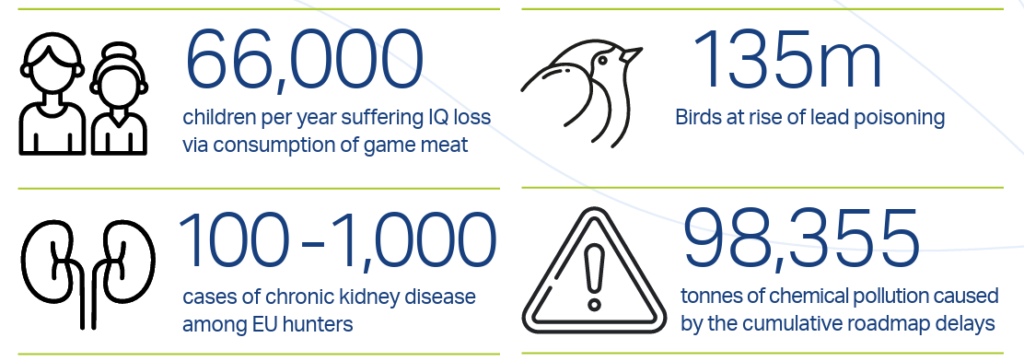
Consequences of the delay in restricting lead in ammunition
Source: Restrictions Roadblock Report, p. 14, European Environmental Bureau & ClientEarth, 2026
How to pave the way forward?
The Court of Justice of the EU has consistently confirmed that public health and environmental protection take precedence over economic interests, even when harm has not fully materialized (for example, in Case T-837/16). However, 20 years of lax implementation of REACH have allowed known harmful chemicals to remain on the market. Chemicals like bisphenols, phthalates, and PVC, known for decades to harm human health and the environment, are still awaiting regulatory action. Therefore, given the previous disappointments:
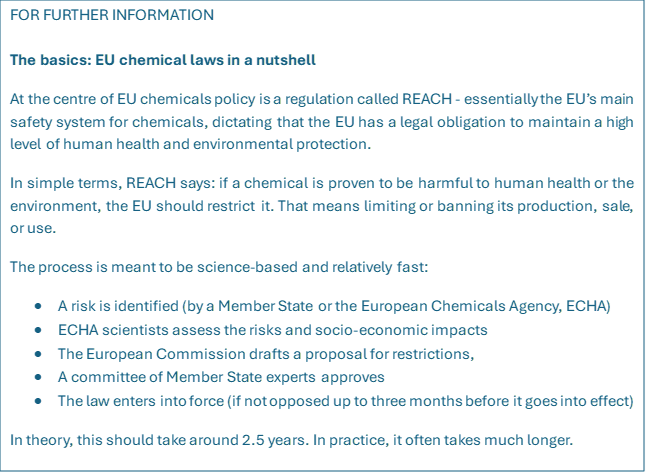
- Stop the delays! The Commission and all other actors in the lawmaking process must respect legal timelines. Priority should be given to meeting the “normal” 2.5-year process from identification to restriction and strict adherence to the requirement for swift, EU-wide restrictive regulatory action where unacceptable risks are identified.
- The Commission should ensure that ECHA and Member States are adequately resourced to fulfil their responsibilities. At the same time, transparency must be significantly improved, as EU authorities have a legal duty to explain the reasoning behind their decisions, including delays, changes in scope, or deviations from scientific opinions.
- Procedural improvements are needed, including establishing clearer standards for assessing chemical risk and alternatives to hazardous chemicals. What exactly counts as an ‘essential’ PFAS use, especially where alternatives are available, should be clearly defined.
- Enforcement of chemicals legislation should be strengthened through increased capacity and effective sanctions. Restrictions should incentivize the development of testing capacity and research and development of safer alternatives.
But promises alone do not clean rivers, protect children’s health, or restore ecosystems. Implementation does.
Four years after the Chemical Strategy for Sustainability, progress is uneven at best. The legal framework exists. Science is clear. What is missing is speed, consistency, and political will.
If the EU is serious about protecting health and nature, chemical regulation cannot remain stuck in slow motion.